
By David
Updated: January 11, 2025
Meta Description:
Curious about the real difference between dogs and wolves? Discover the key distinctions in behavior, genetics, appearance, diet, and more in this expert comparison. Perfect for animal lovers and curious minds alike.
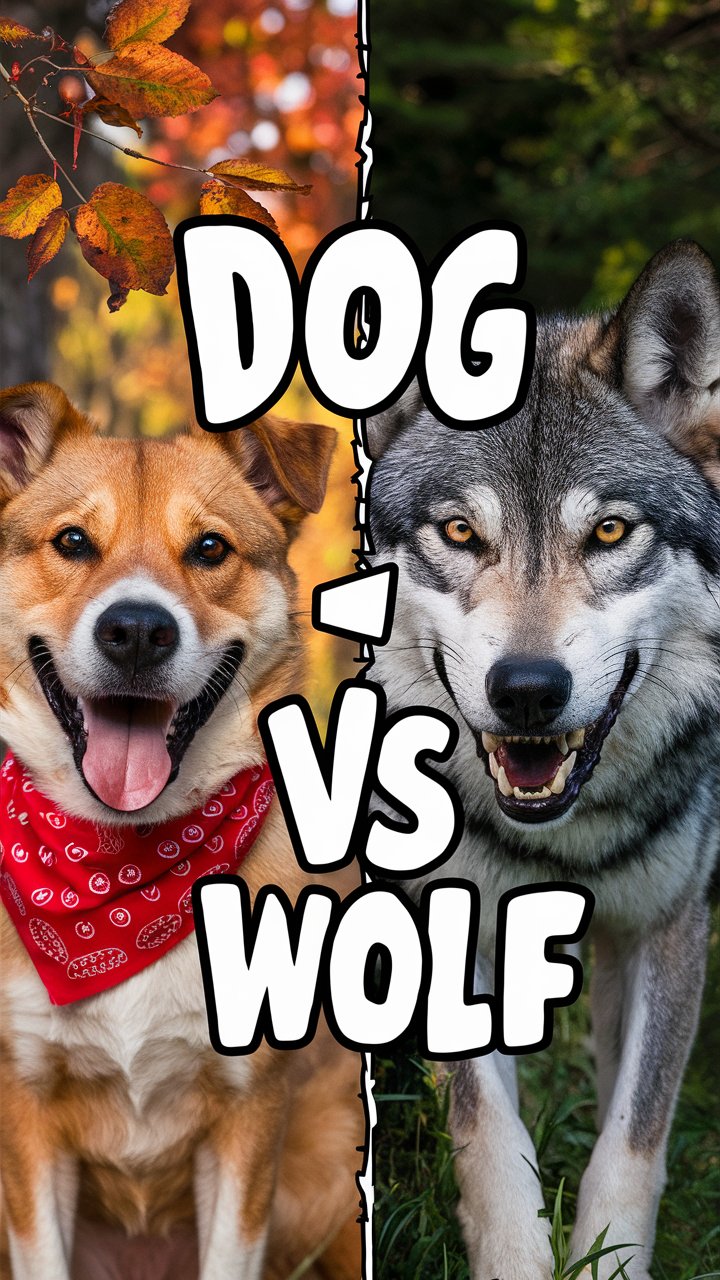
Dogs and wolves—two sides of the same ancient coin.
They share more than 99.9% of their DNA, yet your golden retriever wouldn’t last a night in the wild, while a gray wolf would never beg for belly rubs or cuddle on your couch. So, what happened along the evolutionary trail that turned a ferocious predator into your furry best friend?
Let’s dive deep into the science, behavior, looks, and history of dogs and wolves, one paw print at a time.
💡 Fun Fact: The domestic dog (Canis lupus familiaris) is technically a subspecies of the gray wolf (Canis lupus). Yes, they’re that closely related.
🧬 Origins: From Wild Hunter to Couch Potato
Wolves: Nature’s Original Canine
Wolves have been roaming forests, mountains, and tundras for hundreds of thousands of years. They’re apex predators, highly social, and operate in tight family-oriented packs.
Dogs: Humanity’s First Domesticated Animal
Dogs were domesticated between 20,000 and 40,000 years ago, likely from friendly wolves who learned that hanging around humans meant easy meals. Over time, humans selectively bred them for specific traits—friendliness, size, coat, and behavior.
📜 Scientific Insight: Genetic research suggests domestication began with mutual cooperation—wolves scavenged near humans, and humans began feeding the friendlier ones. That bond eventually evolved into full companionship.
🐕 Physical Differences: Built for Wild vs. Built for Netflix
Though some breeds (like Huskies or Malamutes) still resemble wolves, most dogs are clearly different in build, shape, and stamina.
| Feature | Wolf | Dog |
|---|---|---|
| Size | Tall, lean, muscular | Varies widely—from Chihuahuas to Great Danes |
| Face | Long snout, straight ears, big skull | Wide range—squashed noses, floppy ears, etc. |
| Eyes | Typically amber or yellow | All colors—brown, blue, green, and even mixed |
| Tail | Low-hanging, straight | Curly, straight, waggy—depends on the breed |
| Coat | Dense double coat (built for harsh climates) | Textures and lengths vary—many not weatherproof |
🧠 Why it matters: These physical differences are not just cosmetic—they’re built into their evolution. Wolves needed endurance, strength, and speed. Dogs were bred for roles: herding, guarding, cuddling, even modeling on Instagram.
🐾 Behavior and Social Structure
Wolves: Strict Hierarchies and Wild Instincts
Wolves live in structured packs led by an alpha pair. They’re strategic, coordinated hunters with roles distributed across the pack. Loyalty is strong—but to the pack, not outsiders.
Dogs: Adapted to Human Families
Dogs swapped pack life for human companionship. They’ve evolved to read human facial expressions, body language, and even tone of voice. Many breeds are less territorial and more emotionally responsive.
🧬 Research Note: A study from Science (2005) found that dogs outperform wolves (even wolf-dog hybrids) in understanding human gestures like pointing or gaze direction.
🗣️ Communication: Howls vs. Barks
- Wolves: Use howling to communicate over long distances. It serves to locate pack members, warn rivals, or rally the group.
- Dogs: Bark, whine, growl, howl, sigh, and even “talk.” Barking is rare in wolves and believed to be a domesticated trait amplified by living alongside humans.
🐶 Fun Fact: Some breeds—like Huskies and Basenjis—howl more than bark, hinting at their ancient lineage.
🍖 Diet Differences: Carnivore vs. Omnivore
Wolves: Hardcore Carnivores
Wolves eat meat, period. Elk, deer, bison, and small mammals—they consume bones, organs, and fur for complete nutrition.
Dogs: Opportunistic Omnivores
Dogs have adapted to digest starches and plant matter, thanks to a genetic mutation that allows for amylase production. That’s why your dog can eat veggies (even if they’d prefer steak).
| Food Type | Wolves Eat? | Dogs Eat? |
|---|---|---|
| Raw Meat | ✅ | ✅ |
| Bones & Organs | ✅ | ✅ (with care) |
| Fruits & Veggies | ❌ | ✅ |
| Grains | ❌ | ✅ (moderately) |
🍲 Want to cook for your dog?
Grab our 50 Printable Dog Food Recipes for healthy, vet-friendly meals your pup will love.
🧠 Trainability & Intelligence
- Wolves: Incredibly intelligent but not trainable in the traditional sense. Their independence and instinctual drive override obedience.
- Dogs: Love learning, especially when rewards are involved. From basic commands to complex tricks, dogs thrive on structure and praise.
🧠 Science Says: Dogs are more neophilic (interested in new things) and less neophobic (afraid of new things) than wolves, making them easier to train and socialize.
⚖️ Legality and Ethics: Can You Own a Wolf?
Short Answer: Not advised.
Wolves and high-content wolf-dog hybrids are illegal in many states or require special permits. They’re unpredictable, require massive space, and aren’t emotionally tuned to humans.
⚠️ Hybrid Reality Check:
Wolf-dog hybrids are not like owning an exotic dog. They often have behavioral issues, destructive tendencies, and are prone to escaping.
✅ Want the look without the wild?
Consider these breeds instead:
- Siberian Husky
- Alaskan Malamute
- Tamaskan
- Czechoslovakian Wolfdog (still intense, but trainable)
🌍 Cultural & Symbolic Differences
- Wolves have long symbolized wildness, independence, danger, and strength. Think Game of Thrones or Little Red Riding Hood.
- Dogs are loyalty embodied—heroes in stories, guides for the blind, and guardians of the hearth.
🔍 Quick Recap: Wolf vs. Dog
| Trait | Wolf | Dog |
|---|---|---|
| Domesticated | ❌ Wild animal | ✅ Fully domesticated |
| Pack Structure | Yes (strict hierarchy) | Yes (but now human families) |
| Diet | Obligate carnivore | Omnivore |
| Communication | Howls, growls | Barks, howls, whines |
| Trainability | Low | High |
| Human Affection | Indifferent | Thrives on it |
| Legality as Pet | Rarely legal | Widely accepted |
🏁 Final Verdict: Who Wins?
It’s not a battle—it’s evolution.
If you want:
- A loyal, emotional, trainable companion → Pick a dog
- A mysterious, majestic predator to admire from a safe distance → Respect the wolf
Both animals are masterpieces of nature—one shaped by the wild, the other by 40,000 years of friendship.
🐾 Tell us in the comments: Are you Team Dog or Team Wolf?